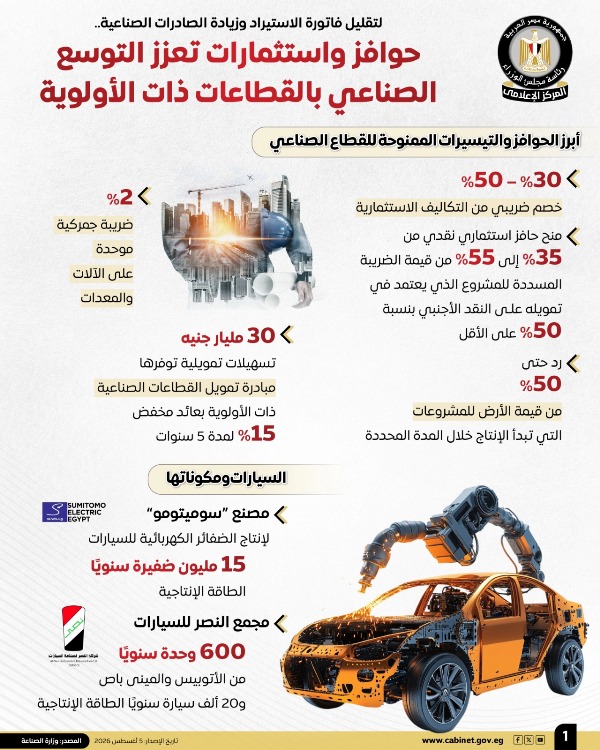
The Cabinet's Media Center published a number of infographics on its social media platforms, highlighting the state's efforts to promote expansion in priority industrial sectors through a comprehensive package of incentives and investments. This aims to reduce the import bill, increase industrial exports, and enhance the competitiveness of Egyptian products in local and global markets.
These efforts come within the framework of the state's strategy aimed at deepening local manufacturing, localizing targeted industries, and increasing the added value of Egyptian products. This is achieved by providing an attractive investment environment, offering integrated financing and tax incentives, and expanding the implementation of major industrial projects in priority sectors. This will enhance the productive capacity of the national economy and support the achievement of sustainable economic development.
The infographics highlighted the most prominent incentives and facilitations granted to the industrial sector. These included a tax discount on investment costs ranging from 30% to 50%, a unified customs duty of 2% on machinery and equipment, and a cash investment incentive ranging from 35% to 55% of the tax paid for projects financed in foreign currency, with at least 50% of the financing coming from foreign currency.
The incentives also included a refund of up to 50% of the land value for projects commencing production within the specified timeframe. Additionally, an initiative was launched to finance priority industrial sectors, providing EGP 30 billion in financing facilities at a reduced interest rate of 15% for a period of five years.
In the same vein, the Egyptian Industry Development Strategy 2030 identified seven priority industrial sectors: ready-made garments, textiles, food processing, pharmaceuticals, automobiles and their components, electrical equipment and engineering industries, and electronics. The infographics highlighted several industrial projects in priority sectors, most notably the automotive and components industry. These included the establishment of the Sumitomo factory for producing automotive wiring harnesses with a production capacity of 15 million harnesses annually and investments totaling €155 million, as well as the Nasr Automotive Complex, which has a production capacity of 600 buses and minibuses annually, in addition to 20,000 cars annually, with investments amounting to EGP 3.5 billion.