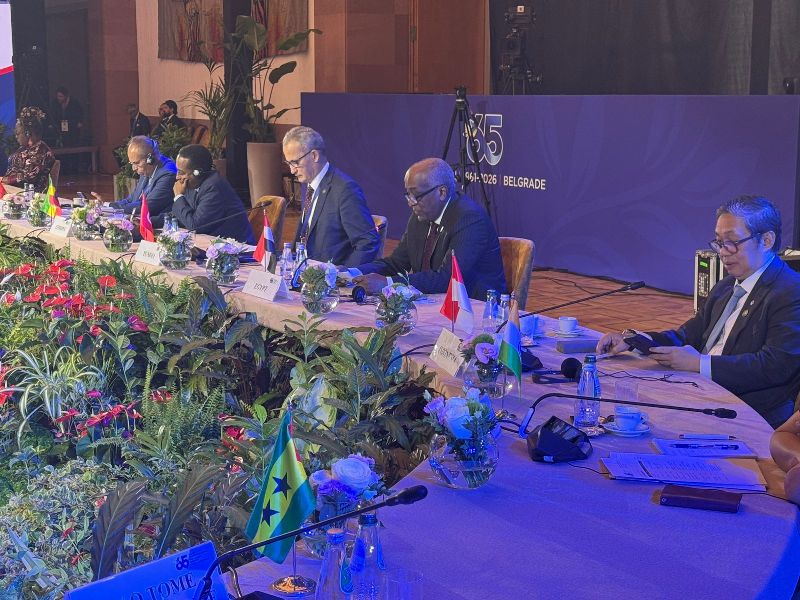
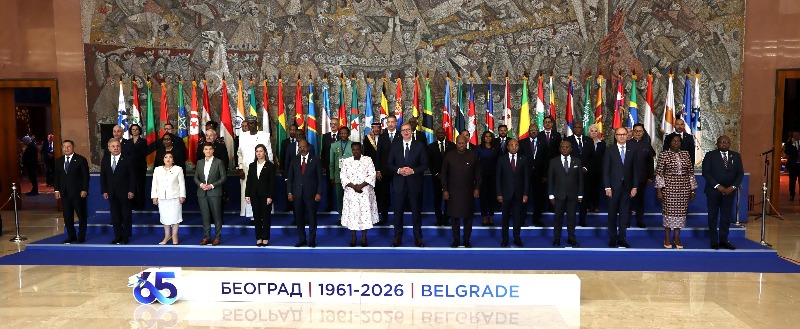
Ambassador Mohamed Abu Bakr, Deputy Foreign Minister for African Affairs, participated in the high-level meeting commemorating the 65th anniversary of the first Summit of Heads of State and Government of the Non-Aligned Movement, hosted by the Serbian capital, Belgrade, with high-level participation from member states of the Movement.
The opening session was attended by Serbian President Aleksandar Vučić and Jessica Olubo, Vice President of the Republic of Uganda, whose country currently holds the chairmanship of the Non-Aligned Movement, along with a number of heads of state and government, senior officials, and representatives of participating countries.
Continuing Close Cooperation with Serbia
At the outset of his remarks to the meeting, the Deputy Foreign Minister conveyed President Abdel Fattah El-Sisi's greetings to President Aleksandar Vučić, and affirmed Egypt's commitment to continuing close cooperation with Serbia to strengthen the strategic partnership between the two countries.
Ambassador Mohamed Abu Bakr emphasized the special place the Non-Aligned Movement holds for Egypt, given its historical and pivotal role in establishing the Movement and shaping its principles. This includes its contribution to laying the foundations for Afro-Asian solidarity during the Bandung Conference in 1955, and the participation of the late President Gamal Abdel Nasser in the first Belgrade Conference in 1961.
The Deputy Foreign Minister also stressed Egypt's adherence to the principles of respecting the sovereignty and territorial integrity of states, non-interference in their internal affairs, the peaceful settlement of disputes, and commitment to international law. He affirmed that non-alignment does not mean neutrality towards international challenges, but rather independence of decision-making and working to ensure that the interests of developing countries and the Global South are represented in the international decision-making process.